


Supplying United States from Türkiye
Selling into the United States is straightforward in one respect and unforgiving in another. There is no pre-approval to obtain for food-contact goods and no certificate is demanded at the border, so a first shipment can move quickly. What catches importers out is everything that is decided before the goods are made: which state the product will be sold in, what its packaging may legally be called, and who carries the liability when a state regulator asks. Almost all of that lands on the importer, not on us.
| Customs duty | 12.5-17.9% depending on the product — the MFN rate plus the Section 301 action; there is no duty-free route as there is into the EU |
|---|---|
| Transit | Sea freight from İstanbul; 6-9 weeks door to door including production |
| Applicable rules | State-level PFAS bans, FDA food-contact rules, and the Lacey Act plant declaration for wooden items |
| Moist towelettes | Regulated as a cosmetic, not as foodware — a separate regime with its own registration |
| Country of origin | "Made in Turkey" must be marked where the final buyer can see it |
There is no A.TR equivalent
European buyers are used to goods from Türkiye arriving duty-free under the Customs Union. That does not apply here. Each product carries its own rate, and the rates are not uniform across a single range: forks and spoons sit on one tariff line and knives on another, so the same cutlery set is charged at two different rates. Invoicing the knives as a separate line is worth doing. Paper napkins carry no duty of their own; their whole burden comes from the trade action. Rates changed twice during 2026, so treat any figure as dated and confirm it with a customs broker against the specific tariff line before you price a contract.
PFAS is the question to settle first, and it is your exposure
There is no federal ban on PFAS in food packaging. Fourteen states have imposed their own, and the wording is consistent: intentionally added PFAS, with some states adding a total organic fluorine threshold. What matters for these products is that paper sleeves are named explicitly — Washington's 2024 category list and Maine's 2026 list both cover "bags and sleeves", which is exactly what a cutlery kit and a wrapped straw are. Washington can ask for a certificate of compliance and expects it within sixty days. The obligation falls on whoever places the product on the state market, so it is the importer who has to be able to answer. Ask us for the declaration at quotation stage; it is not something to discover after a container has landed.
"Compostable" is a certified word here
In Europe the claim rests on EN 13432. In the United States that standard has no legal standing, and the working equivalent is a BPI certification built on ASTM D6400 and D6868. Three points are worth knowing before anyone writes the word on a pack. Several states — Washington, Colorado and Minnesota among them — exempt untreated wood, bamboo and uncoated paper from third-party certification, so much of this range is outside the requirement. California goes further and exempts fibre products from the ASTM requirement altogether. But municipal ordinances and large-account specifications routinely ask for BPI by name, which means the certificate functions as a commercial entry ticket even where it is not a legal one. The safe wording on a claim about fluorinated chemicals is "no added PFAS" rather than "PFAS-free", which is an absolute and harder to defend.
What you may and may not bundle
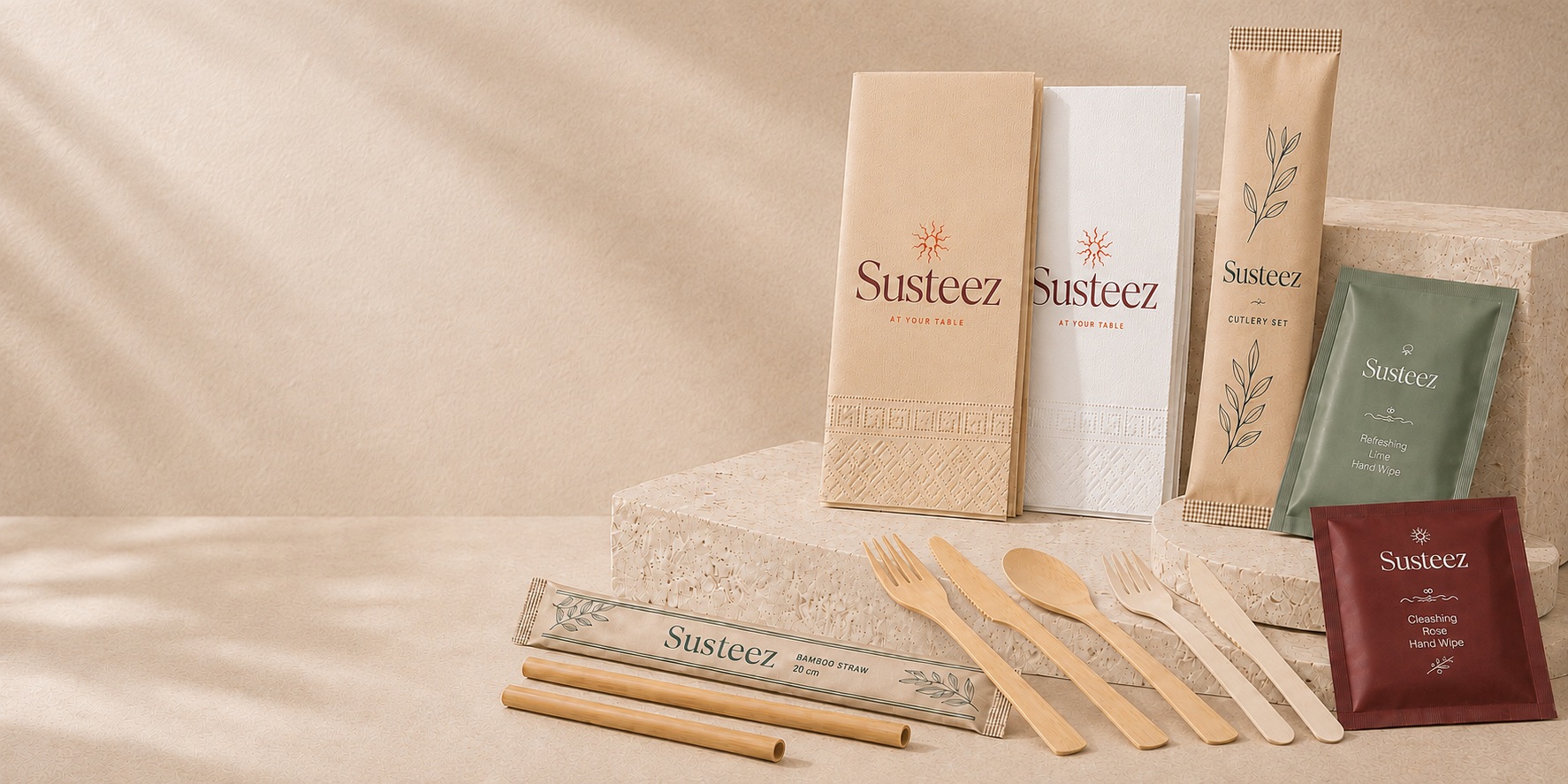
Several states restrict how single-use accessories are handed out. California's rule, in force since 2022, prohibits bundling utensils, straws and condiment packets in a way that stops the customer taking only the item they want; Washington and New Jersey have comparable rules and Colorado's, which also covers napkins, begins in 2027. The duty sits with the food facility rather than the supplier, and the penalty is small, but it shapes what is worth ordering. Cutlery with a napkin is outside the definition — napkins are not listed as an accessory. Adding a straw or a condiment packet to the same sleeve is what the rule describes. Because our kit is configured rather than fixed, this is a choice made at order stage, not a limit on the product.
Lead time means something different here
Our published production times are production times: the days the goods spend being printed, filled and packed, counted from artwork approval. A US buyer comparing suppliers usually means time to the door. With sea freight the honest figure is six to nine weeks in total. That is still roughly half of what custom-printed overseas programmes in this category typically quote, but it should be said as a total rather than as a production figure, and it is the reason to hold stock locally once a design repeats.
We can supply the PFAS declaration, the plant species and harvest country for the Lacey filing, and the material composition behind any claim you want to make. What we cannot do is act as importer of record or register on your behalf with a state programme — those sit with the party bringing the goods in. Tell us the destination states at quotation stage and we will set the artwork and the paperwork up for them from the start.
Most ordered for this market
Tell us the market at quotation stage. It changes the marking language on the artwork and, on wet wipes, sometimes the specification itself.
Request samples